
Combining evidence based elements from the Gottman Method, Emotionally Focused Therapy and Energy Psychology may help you respond (pause) rather than react (pounce) to what you just heard your partner say. You know the moment. Your partner says something (maybe offhand, maybe pointed) and before you’ve consciously decided anything, your chest tightens, your voice sharpens, and you’re already mid-sentence. Or you go the other way: you go quiet, flat, far away.
That’s a reaction. It happens to you. A response, on the other hand, is something you choose. In my work with couples, I’ve found that the distance between the two is rarely about willpower or communication “tricks.” It’s about understanding what’s happening in your body, your attachment system, and your relationship pattern, and then giving yourself a few skills to widen that gap.
Here’s how three lenses (Emotionally Focused Therapy, the Gottman Method, and energy psychology) can work together to help.
The EFT lens: you’re not fighting about the dishes
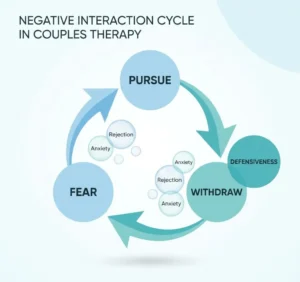 In Emotionally Focused Therapy, we understand conflict as a cycle rather than a problem with either person. One partner pursues, criticizes, or protests; the other withdraws, defends, or shuts down. The more one pushes, the more the other retreats, and the more the other retreats, the harder the first pushes. Sue Johnson called one version of this the “protest polka.”
What’s underneath the cycle is the key. Anger, criticism, and stonewalling are usually secondary emotions, the visible tip. Beneath them sit the primary emotions: fear of losing connection, loneliness, shame, a quiet “Do I matter to you?”
Reacting means speaking from the tip: “You never listen to me!” Responding means reaching for what’s underneath: “When you turned back to your phone, I felt invisible, and that scared me.”
The second sentence is vulnerable, and that’s exactly why it works. It invites your partner toward you instead of triggering their defenses.
The Gottman lens: when your body hijacks the conversation
 John and Julie Gottman’s research gives us a very practical piece of the puzzle: flooding. When conflict escalates, your heart rate climbs, stress hormones surge, and the thinking part of your brain gets harder to access. In the Gottman lab, a heart rate above roughly 100 beats per minute was a red flag that productive conversation had become very difficult.
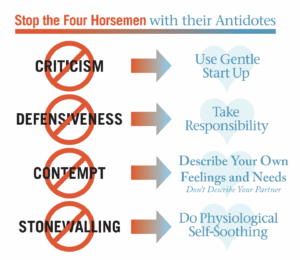
When you’re flooded, you’re far more likely to slide into what the Gottmans call the Four Horsemen: criticism, contempt, defensiveness, and stonewalling. That’s not a character flaw. It’s physiology.
Their antidotes are wonderfully concrete:
- Soften your startup. Begin with a gentle, specific complaint rather than a blame-filled attack. “I’m feeling overwhelmed with the evening routine and I’d love your help” lands very differently than “You never do anything around here.”
- Take a real break. If either of you is flooded, pause the conversation for at least 20 minutes, and spend that time actually calming down (not rehearsing your rebuttal).
- Make and accept repair attempts. A touch of humor, a “Can we start over?”, or “I’m getting defensive, and I don’t want to” can de-escalate a fight mid-stream. Couples who accept each other’s repair attempts tend to fare far better.
The energy psychology lens: regulate the body first
Both EFT and Gottman point to the same truth: you can’t respond well from a dysregulated nervous system. This is where energy psychology approaches, such as tapping (often called Emotional Freedom Techniques, or “EFT tapping”), can offer a practical, in-the-moment tool.
A quick note, because the acronym is confusing: Emotionally Focused Therapy and EFT tapping are entirely different things, with different origins and different evidence bases.
Tapping involves lightly tapping with your fingertips on a sequence of points (typically the side of the hand, eyebrow, side of the eye, under the eye, under the nose, chin, collarbone, and under the arm) while naming what you’re feeling. Many people find it grounding, and it combines several things we know help: focused attention, labeling emotion out loud, slow breathing, and physical touch.
I want to be transparent about where the science stands. Research on energy psychology is mixed. Some studies show reductions in distress and anxiety, but critics point out that the claimed “energy meridian” mechanism lacks support, and that benefits may come from the well-established ingredients above (exposure, attention, self-soothing) rather than anything specific to the tapping points. I offer it as a self-regulation tool, one option among several, rather than a cure or a replacement for therapy. If it helps you calm down, great; if it doesn’t, a slow exhale or a cold glass of water will do the job too.
Try this the next time you feel the surge:
- Tap through the sequence slowly.
- Say, out loud or silently, “I’m feeling [angry / scared / dismissed], and that’s okay. I’m safe right now.”
- Take a long exhale between rounds.
- Notice when your shoulders drop and your breath deepens.
Putting it together: Notice, Regulate, Name, Reach
Here’s a simple four-step practice that weaves all three approaches together:
1. Notice. Catch the early signs: jaw clenching, heat in your face, a sinking feeling, the urge to leave the room. Name the moment: “I’m getting activated.”
2. Regulate. Before you say anything important, bring your body down. Breathe, tap, step outside, or take that 20-minute break (and tell your partner you’re coming back; a break that feels like abandonment will only fuel the cycle).
3. Name what’s underneath. Ask yourself, “What’s the softer feeling beneath the anger or the shutdown? What do I need from my partner right now?”
4. Reach. Speak from that softer place, gently and specifically. “I got overwhelmed and needed a minute. What I’m really needing is to feel like we’re on the same team.”
None of this makes you a robot. You’ll still get triggered; everyone does. The goal isn’t to never react. It’s to get faster at noticing, kinder with yourself, and quicker to repair. Over time, the cycle that once ran the show becomes something the two of you can see, name, and step out of together.
A closing invitation
This week, pick one moment, just one, where you pause before reacting. Notice what you feel, what’s underneath it, and what happens when you reach instead of strike. Small shifts in these moments are how secure, resilient relationships get built.
If your cycle feels stuck, couples therapy can help you map it and find your way out together. You don’t have to do it alone.
Michaela Conley is a couples therapist trained in Emotionally Focused Therapy and the Gottman Method, serving clients in Arizona, Virginia, and Florida.